What it costs the public
The public’s share of this project arrives as roads — four roundabouts and two corridor rebuilds, dedicated to the county to maintain in perpetuity, and booked in the agreement that authorizes them as a private contribution from the developer. The estimate that sets the price is a Tetra Tech Opinion of Probable Cost. Read it the way an engineer would: start from the total, then ask what the total leaves out.
Opinion of Probable Cost
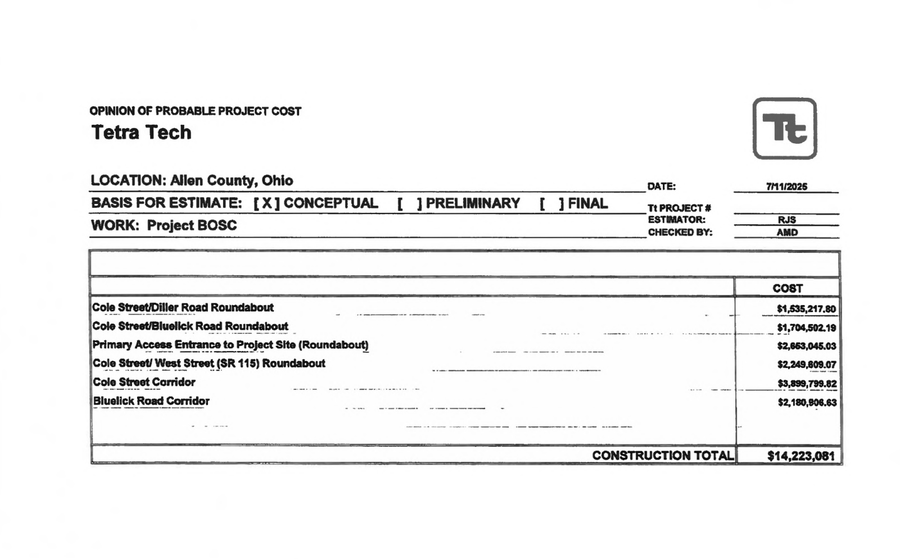
The public's road package is priced to the dollar — $14,223,081 — yet drainage is just 7.5% of it, the only one of six items detailed, with no design-storm basis and no detention shown. A number that precise on a scope that thin is the tell.
and then — that $14.2M estimate becomes a “private” contribution in the deal itself, where the clauses decide who really pays.
Roadwork Development Agreement
A public roundabout package is booked as a private gift of $14,500,000 — but §5.5 lets public grants refund the developer, §9.13 demands notice before any record is released, and §9.17 waives competitive bidding. The label says “private”; the clauses say otherwise.
Read together, the two records say the same thing twice: a public-works number precise to the dollar sitting on a scope thin enough to hide a floodplain, wrapped in a contract whose quiet clauses decide who actually carries the cost.
Follow the money
| Stage | Amount | Source |
|---|---|---|
| Collected · “Company Contribution” | $14,500,000 | RDA §3.2(a) — one-time Company Contribution, due within 30 business days |
| — Cole Street / Diller Road Roundabout | $1,535,218 | OPC line item (records feed) |
| — Cole Street / Bluelick Road Roundabout | $1,704,502 | OPC line item (records feed) |
| — Primary Access Entrance to Project Site (Roundabout) | $2,663,045 | OPC line item (records feed) |
| — Cole Street / West Street (SR 115) Roundabout | $2,249,609 | OPC line item (records feed) |
| — Cole Street Corridor | $3,899,800 | OPC line item (records feed) |
| — Bluelick Road Corridor | $2,180,907 | OPC line item (records feed) |
| Tetra Tech OPC estimate · total | $14,223,081 | aedg/roundabouts.summary.opc.yaml (records feed) |
| First actual award · Eagle Bridge (N. Cole) | ~$3,520,000 | PAAC board minutes 2026-04-23 (p.78) — ~$3.52M; the rest of the program is still being awarded |
§5.5 grant-refund [inference] | surplus → developer | RDA §5.5 Overpayment Amount · turns on grant awards not in the document |
The parallel strand — the abatement
A 75% real-property abatement for 15 years on a ~$500M build, pulled from the Elida Local School District tax base — and the land was CAUV farmland, so converting it triggers tax recoupment. The public return: ~50 jobs / ~$4M payroll by 2030, from near-zero today.
What the abatement costs per job is the deciding number, and the record that would pin it — the School District Compensation Agreement — is non-public. So we don’t leave the blank, and we don’t invent a figure: we model it, and carry the answer as [open] until the record arrives. Across a few facility profiles the value lands between $0.6M and $2.1M per job — about $0.9M if you take the application’s own ~50 jobs at face value. Every one of those dwarfs the ~$80,000 a job pays in a year.
| Profile | Building share | Jobs | Per job |
|---|---|---|---|
| Take the application at its wordthe CRA's own ~50 jobs; a mid building-shell share of the $500M | 35% | 50 | $0.9M |
| AI / GPU-dense (equipment-heavy)most value is servers + electrical — personal property, not abated — so the abated base shrinks | 25% | 50 | $0.6M |
| Hyperscale-realistic (lean ops)data centers staff lean at steady state; the CRA warns actuals 'may differ significantly' | 35% | 30 | $1.4M |
| GovCloud / defense-hardenedhardened construction lifts the real-property share, cleared ops run lean — a what-if profile, not a finding (#233) | 50% | 30 | $2.1M |
How it’s modeled. 75% × 15-yr abatement
[verified] (Res #548-25) on the building share of the ~$500M build
[verified] (CRA §2, a non-binding estimate), taxed at Ohio’s 35%
assessment [verified] × ~63 effective mills
[assumption] (the exact Elida rate isn’t in the corpus). The result is a screening band,
[open] — the real number is owed to the non-public School District Compensation Agreement.
The roads are the part you can see
The roundabouts are the visible public cost. Two larger ones sit just outside the frame.
The first is the pipe the water chapter handed off: to carry the campus’s cooling blowdown
and sewage, the county is building a BOSC pump station and dual forcemains, and that
construction estimate rose from $20,250,000 to $29,834,256 in eight months
— a ~47% jump between the June 2025 engineering advertisement (Res #469-25) and the
February 2026 construction-manager RFQ (Res #137-26). [verified], from the
produced resolutions. The roads are dedicated to the county “in perpetuity”; the sewer is
sized to a single customer.
The second is a subsidy the abatement above doesn’t count. The CRA this chapter models
abates real property — land and buildings — only. But Ohio’s signature
data-center incentive is a different instrument: the Data Center Tax Exemption
(DCTE, from HB 59), which waives the sales-and-use tax on the equipment — the
servers and the cooling plant, the tangible bulk of a $500M-plus build, and the part that
gets replaced every three to five years. Whether this campus holds a DCTE isn’t in the
record, so we carry it [open] — but it is the standard companion to a
real-property abatement, and if it’s here, the public’s contribution isn’t the roads plus
the sewer plus the abatement. It’s all of that, plus the larger number nobody has had to
publish.
One document would total it. Across Ohio’s thirteen data-center deals approved through
September 2024 — about $5.1 billion in investment — the state booked
356 jobs and $31.6M in payroll against an estimated $281.9M
in forgone revenue: closer to $1 million of public cost per job
([reference], Policy Matters Ohio / state development figures). The analysis
that would run that arithmetic for this deal — the county’s own cost-benefit study,
item 4 of the records request — is the one document the production withheld. In a sense the
chapter you’re reading is the cost-benefit analysis the public was refused.